ASE 2025 / Multimodal AIOps
TrioXpert: An Automated Incident Management Framework for Microservice System
Yongqian Sun1,7, Yu Luo1, Xidao Wen4,*, Yuan Yuan6, Xiaohui Nie2, Shenglin Zhang1,5, Tong Liu3, Xi Luo3
1Nankai University 2Computer Network Information Center, Chinese Academy of Sciences 3Lenovo (Tianjin) Co., Ltd. 4BizSeer
5Key Laboratory of Data and Intelligent System Security, Ministry of Education, China 6National University of Defense Technology 7Tianjin Key Laboratory of Software Experience and Human Computer Interaction
ASE 2025
* Corresponding author
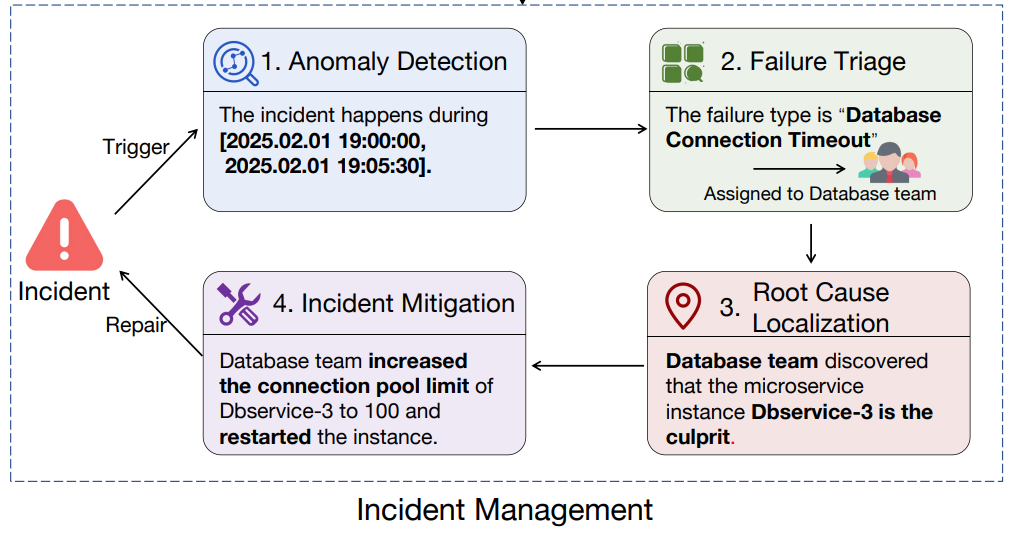
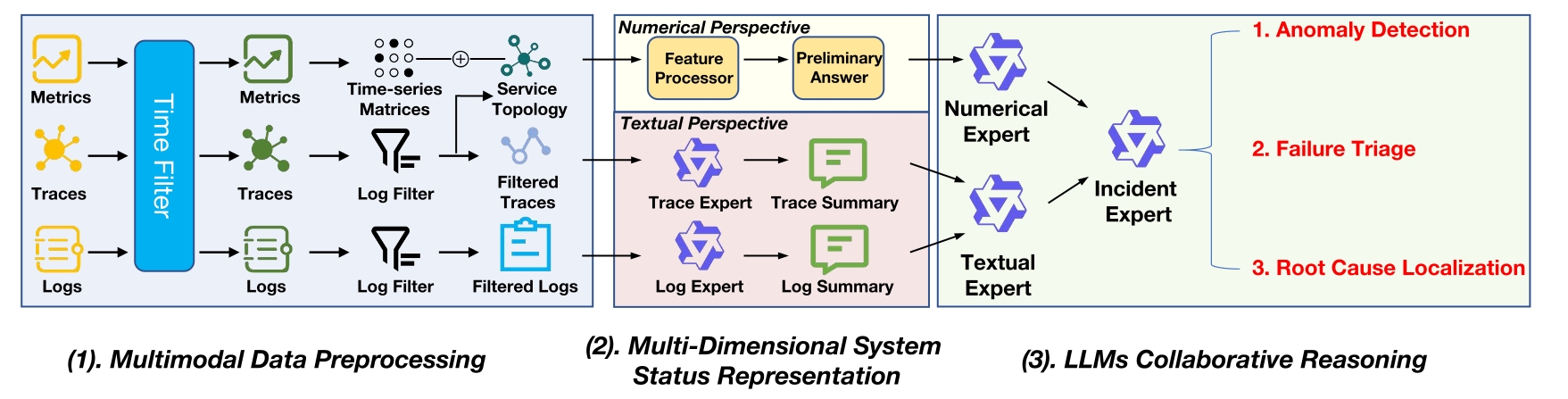
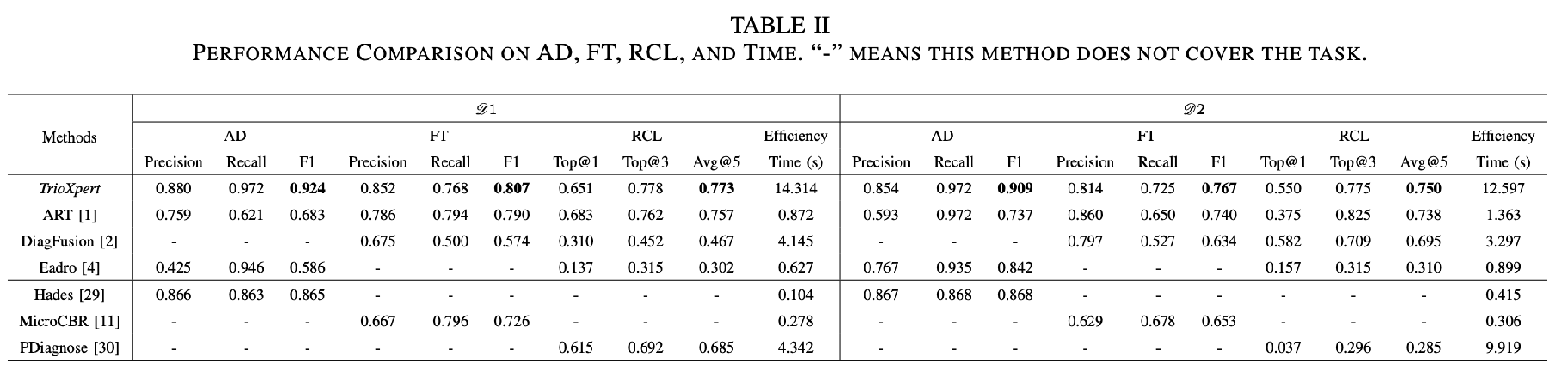
Automated incident management plays a pivotal role in large-scale microservice systems. However, many existing methods rely solely on single-modal data (e.g., metrics, logs, and traces) and struggle to simultaneously address multiple downstream tasks, including anomaly detection (AD), failure triage (FT), and root cause localization (RCL). Moreover, the lack of clear reasoning evidence in current techniques often leads to insufficient interpretability. To address these limitations, we propose TrioXpert, an end-to-end incident management framework capable of fully leveraging multimodal data. TrioXpert designs three independent data processing pipelines based on the inherent characteristics of different modalities, comprehensively characterizing the operational status of microservice systems from both numerical and textual dimensions. It employs a collaborative reasoning mechanism using large language models (LLMs) to simultaneously handle multiple tasks while providing clear reasoning evidence to ensure strong interpretability. We conducted extensive evaluations on two microservice system datasets, and the experimental results demonstrate that TrioXpert achieves outstanding performance in AD (improving by 4.7% to 57.7%), FT (improving by 2.1% to 40.6%), and RCL (improving by 1.6% to 163.1%) tasks. TrioXpert has also been deployed in Lenovo's production environment, demonstrating substantial gains in diagnostic efficiency and accuracy.
Project Overview
Multimodal Evidence
TrioXpert treats metrics, logs, and traces according to their own data characteristics, using numerical and textual views to describe the system state more completely.
Multi-Task Management
The framework covers anomaly detection, failure triage, and root cause localization in one end-to-end incident management workflow.
Interpretable Reasoning
LLM-based experts cooperate over structured evidence, producing reasoning traces that help OCEs inspect why a diagnosis was made.
@inproceedings{sun2025trioxpert,
  title={TrioXpert: An Automated Incident Management Framework for Microservice System},
  author={Sun, Yongqian and Luo, Yu and Wen, Xidao and Yuan, Yuan and Nie, Xiaohui and Zhang, Shenglin and Liu, Tong and Luo, Xi},
  booktitle={2025 40th IEEE/ACM International Conference on Automated Software Engineering (ASE)},
  pages={3239--3250},
  year={2025},
  organization={IEEE}
}