ISSRE 2026 Dual-Memory Diagnosis

OpsMem: Dual-Memory Reasoning with Cross-Memory Resonance for Failure Diagnosis

Yongqian Sun1,*, Rongchen Gao1, Yu Luo1, Wenwei Gu1, Shenglin Zhang1, Qingyi Guo2, Qiuai Fu3, Yaoliang Wu3, Dan Pei2

1Nankai University   2Tsinghua University   3Huawei Technologies Co., Ltd.

ISSRE 2026

* Corresponding author

OpsMem dual-memory reasoning framework
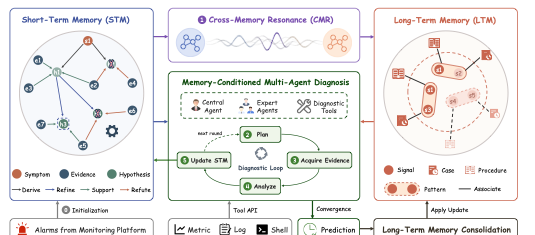
OpsMem couples an evolving short-term diagnostic state with long-term operational experience through cross-memory resonance.

01 THE PAPER

Abstract

Failure diagnosis in modern software systems requires iterative evidence acquisition and hypothesis reasoning guided by operational experience. Existing LLM-based methods improve diagnosis through agentic reasoning or knowledge augmentation, but they often lack a mechanism to coordinate the evolving diagnostic state with operational experience during iterative diagnosis. We propose OpsMem, a dual-memory framework that maintains a short-term memory for the current diagnostic state and a long-term memory for reusable operational experience. OpsMem uses cross-memory resonance to activate state-relevant long-term memory, conditions multi-agent diagnosis on the short-term and activated long-term memories, and consolidates reusable experience from solved incidents back into long-term memory. Experiments on a real-world Huawei microservice failure diagnosis dataset show that OpsMem outperforms representative agentic-reasoning and knowledge-augmented baselines, improving Match and Relevant by up to 46.88% and 18.39% over the strongest baseline, respectively.

Project Overview

Short-Term Memory

A graph-structured memory of the current diagnostic state: observed symptoms, acquired evidence, and candidate hypotheses with their relationships.

Long-Term Memory

Reusable operational experience distilled from past incidents: diagnostic patterns, cases, and procedures that future incidents can draw on.

Cross-Memory Resonance

The coupling mechanism that activates state-relevant long-term memory as the diagnostic state evolves, so retrieved experience matches what the diagnosis needs now.

02 THE FRAMEWORK

Method

OpsMem coordinates two memories during iterative, multi-agent failure diagnosis, and learns from every solved incident.

Resonate

Cross-memory resonance couples the short-term state with long-term experience through signal coupling, pattern activation, and memory propagation, retrieving the cases and procedures that the current hypotheses actually need.

Diagnose

Multi-agent diagnosis is conditioned on both the short-term memory and the activated long-term memory, so evidence acquisition and hypothesis updates stay aligned with relevant operational experience.

Consolidate

After an incident is solved, consolidation distills reusable experience back into long-term memory, so the knowledge available to future diagnoses keeps growing.

03 EVALUATION

Experimental Results

Results at a Glance

Evaluation on 120 real-world failure incidents from Huawei production microservice systems, against agentic-reasoning and knowledge-augmented baselines (ReAct, GoS, VectorRAG, GraphRAG, LinearRAG). Improvements are relative to the strongest baseline (Table I).

Match

up to +46.88%

Relative improvement over strongest baseline

Match measures agreement with the reference diagnosis. The figure is a relative improvement, not an accuracy value.

Table I

Relevant

up to +18.39%

Relative improvement over strongest baseline

Relevant measures how much of the reference diagnosis the answer covers. Also a relative improvement, not accuracy points.

Table I

Evaluation data

120 incidents

Real-world Huawei failures

Production microservice incidents. The public release contains one sanitized case and a small sanitized seed knowledge base, not the full dataset.

Experiments

04 START FROM THE CODE

Run the Code

The public release contains the framework code, one sanitized example case, and a small sanitized seed knowledge base. The full dataset and knowledge base are not publicly released.

Before running

  1. Create a Python 3.10 conda environment and install requirements.txt.
  2. Configure the model settings in code/config.yaml before running.
  3. Run the entry script from the code directory of the repository.
Run after setup
# From the repository's code directory, after configuring config.yaml
python main.py

Output

The pipeline runs failure diagnosis over the configured case and writes evaluation outputs.

Repository entry point; local data and model setup are required.

05 FREQUENTLY ASKED

Frequently Asked Questions

What is OpsMem?

OpsMem is a dual-memory reasoning framework for failure diagnosis, accepted at ISSRE 2026. It maintains a short-term memory for the current diagnostic state — observed symptoms, acquired evidence, and candidate hypotheses — and a long-term memory of reusable operational experience, and connects the two through cross-memory resonance.

What problem does it solve, and how?

Existing LLM-based diagnosticians either reason without operational experience or retrieve knowledge that ignores where the diagnosis currently stands. OpsMem's cross-memory resonance activates state-relevant long-term memory as the diagnostic state evolves, conditions multi-agent diagnosis on both memories, and consolidates reusable experience from solved incidents back into long-term memory for future incidents.

What was evaluated, and what were the results?

OpsMem was evaluated on 120 real-world failure incidents from Huawei production microservice systems, against agentic-reasoning and knowledge-augmented baselines including ReAct, GoS, VectorRAG, GraphRAG, and LinearRAG. It improves Match and Relevant by up to 46.88% and 18.39% over the strongest baseline respectively (Table I). These are relative improvements, not accuracy points.

How can I use it, and what are its limitations?

The framework code is open at github.com/gaorch85/OpsMem under Apache-2.0, including one sanitized example case and a small sanitized seed knowledge base. The full dataset and knowledge base cannot be publicly released due to confidentiality and compliance restrictions, so results on the private Huawei data are not reproducible from the public release alone.

06 CITE THIS WORK

BibTeX

@article{sun2026opsmem,
  title={OpsMem: Dual-Memory Reasoning with Cross-Memory Resonance for Failure Diagnosis},
  author={Sun, Yongqian and Gao, Rongchen and Luo, Yu and Gu, Wenwei and Zhang, Shenglin and Guo, Qingyi and Fu, Qiuai and Wu, Yaoliang and Pei, Dan},
  journal={arXiv preprint arXiv:2607.11357},
  year={2026}
}